
Commercial Window Tinting in West Kelowna: 2026 Facility Buying Guide

Treating an architectural building facade like an oversized car window is one of the costliest mistakes a facility manager can make. When evaluating commercial window tinting West Kelowna property managers quickly realize that commercial glazing demands engineered architectural films matched precisely to glass physics, rather than generic automotive materials.
You already know how punishing Okanagan summers can be on your operating budget. Unchecked solar heat gain forces cooling systems to run continuously, while severe reflection off Okanagan Lake washes out office monitors and compromises retail customer comfort. Beyond daily tenant frustration, the fear of inducing glass thermal stress or causing insulated seal failures makes choosing the correct film feel like a high-stakes decision.
The right architectural film balances solar rejection and structural safety, significantly lowering cooling overhead while protecting storefront displays from UV fading and physical intrusion. This 2026 buying guide outlines how to assess specialized solar and security films for your building orientation, avoid thermal shock, and choose an experienced Okanagan glazier who delivers lasting performance.
Table of Contents
Evaluating Commercial Window Tinting for West Kelowna Facilities
Commercial building envelopes face intense environmental forces that automotive tint shops simply aren't equipped to address. Investing in commercial window tinting West Kelowna properties require is not just about darkening glass; it is a calculated architectural upgrade. Applying specialized architectural window film modernizes commercial glazing performance, delivering robust thermal control and exterior aesthetic uniformity without the massive capital disruption of full window frame replacements.
Okanagan Climate Pressures on West Kelowna Commercial Properties
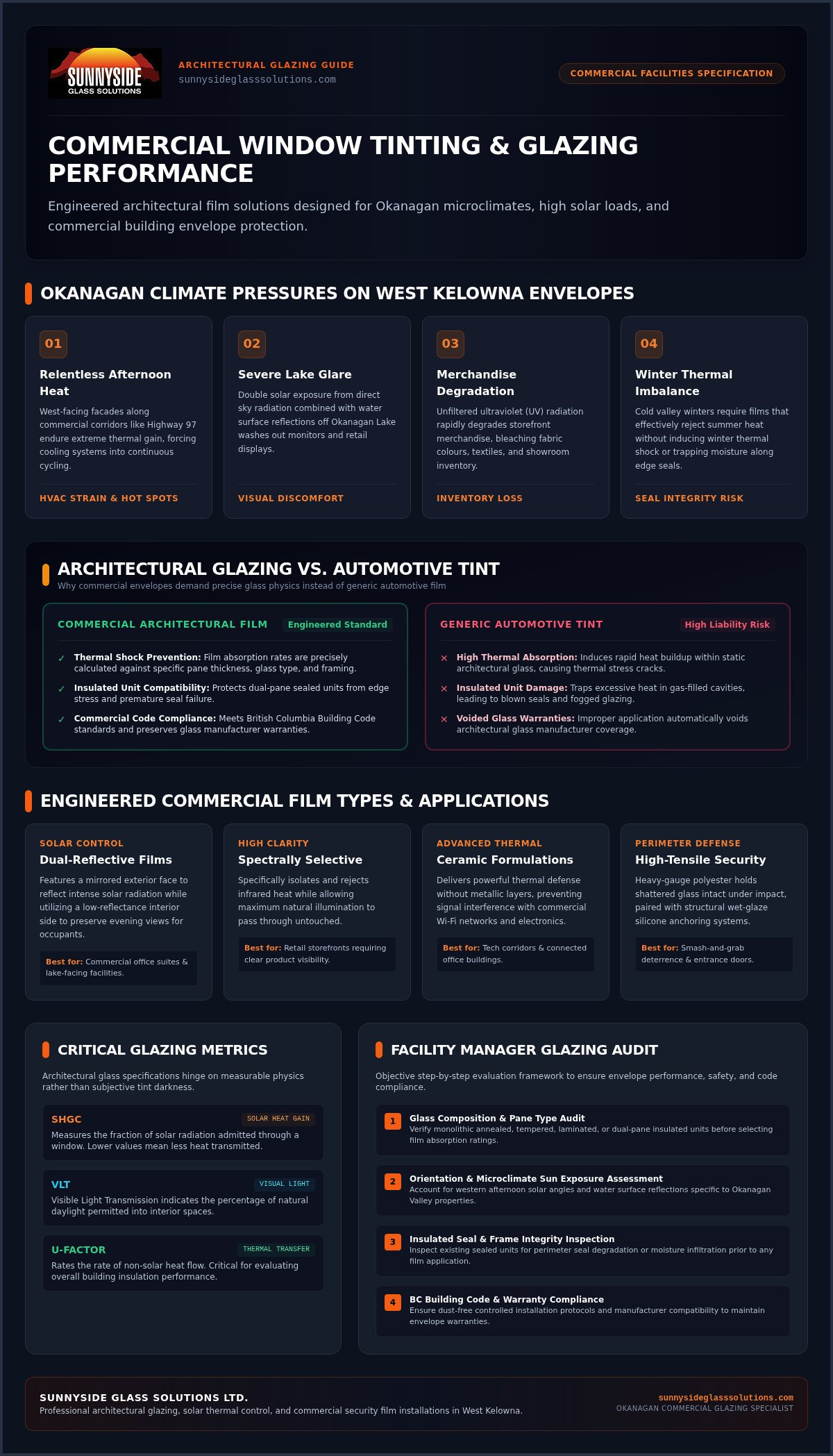
Commercial corridors in West Kelowna experience severe microclimates. Facades facing west along Highway 97 absorb relentless afternoon heat, while properties facing Okanagan Lake endure double solar exposure from direct sunlight and blinding water surface reflection. This intense solar gain creates specific building challenges:
Merchandise degradation: Harsh ultraviolet radiation damages storefront retail displays, fading textiles and inventory within weeks.
Severe lake glare: Unfiltered light reflecting off Okanagan Lake washes out computer monitors and diminishes customer comfort in office suites and restaurants.
Winter thermal imbalance: Cold valley winters demand solutions that reject summer heat without inducing winter thermal stress or trapping perimeter moisture along window seals.
Immediate Operational and Financial Paybacks for Local Facilities
Every facility manager tracks operational overhead closely. Specialized solar film directly lowers a building's Solar Heat Gain Coefficient (SHGC), meaning cooling units run less frequently during peak summer heat waves. By stabilizing indoor ambient temperatures, commercial facilities eliminate uncomfortable hot spots near exterior perimeter glazing, boosting tenant productivity and comfort.
Choosing an engineered film applied by an experienced glazing specialist ensures the thermal absorption rate matches the exact glass composition of your building. Reviewing the standards for professional window film installation highlights why commercial window tinting West Kelowna businesses rely on must account for pane thickness, interior airflow, and exterior exposure. When properly calculated, commercial window film acts as an immediate capital improvement that protects mechanical equipment, reduces HVAC strain, and preserves the pristine exterior appearance of your commercial facility.
Key Architectural Film Types and Performance Specifications
Every commercial facility operates under distinct structural parameters. Choosing the appropriate film requires balancing building orientation, daylighting needs, and physical asset protection. Commercial window tinting West Kelowna facilities install encompasses diverse architectural categories engineered to solve specific operational challenges, from solar heat rejection to perimeter hardening.
Solar Control and Dual-Reflective Architectural Films
Solar control films target infrared heat while maintaining exterior aesthetics. Dual-reflective films use a mirrored exterior face to reflect intense solar radiation while featuring a low-reflectance interior side, preserving evening outdoor visibility for building occupants. For retail storefronts where clear product visibility remains mandatory, spectrally selective films isolate and reject infrared heat while allowing maximum natural illumination inside. Ceramic formulations deliver powerful thermal defense without metallic layers, preventing signal interference with commercial Wi-Fi networks.
Commercial Security and Storefront Protective Films
Perimeter protection is essential for commercial corridors. High-tensile polyester security films hold glass shards intact under blunt impact, deterring opportunistic smash-and-grab attempts. Installing structural wet-glaze silicone anchoring systems secures the filmed pane to the commercial frame, preventing forced entry. Reviewing our resource on commercial security window film in the Okanagan provides a deeper look at protecting local retail assets.
Critical Glazing Metrics: Deciphering SHGC, VLT, and U-Factor
Architectural glass specifications hinge on measurable physics rather than shade darkness. Consulting industry-standard window film performance specifications helps facility managers interpret technical data sheets accurately:
Solar Heat Gain Coefficient (SHGC): Measures the fraction of solar radiation entering the building. Lower ratings mean superior heat rejection.
Visible Light Transmission (VLT): Dictates the percentage of daylight passing through the glass, balancing internal brightness with glare reduction.
Internal Reflectance: Lower interior reflective ratings prevent interior mirror effects at dusk, keeping office spaces pleasant under indoor lighting.
U-Factor: Indicates the overall rate of heat transfer through the glazing assembly, reflecting thermal insulation efficiency.
Pairing these metrics with decorative or frosted privacy films allows medical centres and professional offices to create private boardrooms without costly renovations. If you want to identify the right performance rating for your building facade, consider consulting a specialist at Sunnyside Glass Solutions for technical glazing advice.
Commercial Window Tinting Selection Framework for Facility Managers
A structured evaluation process prevents costly glazing failures and ensures lasting return on investment. When commissioning commercial window tinting West Kelowna property managers need a methodical protocol to assess their building's specific architectural envelope:
Step 1: Conduct an architectural solar audit: Map exterior glazing by compass orientation, seasonal sun angles, and exterior shading factors.
Step 2: Inspect existing insulated glass units (IGUs): Identify pre-existing seal failures, glass scratches, or edge micro-fissures before applying any film.
Step 3: Evaluate spatial operational requirements: Differentiate solar loads between perimeter executive offices, server rooms with severe internal heat gains, and public display floors.
Step 4: Balance exterior aesthetics and zoning: Ensure exterior reflectance levels complement corporate branding and municipal frontage expectations.
Step 5: Verify film-to-glass compatibility: Confirm that the chosen film's solar absorption profile matches the structural thermal tolerances of the underlying glass assembly.
Assessing Glass Compatibility and Thermal Stress Risks
Double-glazed insulated units expand and contract under daily thermal shifts. When dark solar film is applied to unconditioned, tinted, or laminated glass, solar absorption rates spike drastically. If the centre of the pane heats significantly faster than the shielded glass edges inside the framing channel, thermal stress fractures can occur. If your pre-installation audit reveals cloudy panes or moisture ingress, completing sealed window unit replacement in the Okanagan before installing film is essential to preserve your structural envelope and warranty coverage.
Balancing Glare Reduction Against Natural Daylight Harvesting
Selecting an overly dark tint introduces an unexpected operational penalty: elevated electrical consumption from artificial interior lighting, which cancels out cooling efficiency gains. Effective daylight harvesting pairs heat rejection with balanced natural illumination. Workstations situated along perimeter walls facing the afternoon sun benefit from neutral films with roughly 50% VLT, softening harsh glare without creating an overly dim interior. Retail showrooms, conversely, require high-transmittance spectrally selective films so prospective customers outside can view display merchandise with absolute colour clarity. Implementing commercial window tinting West Kelowna facilities rely on preserves natural ambience while shielding occupants from harsh seasonal extremes.
Commercial Installation Protocols, Warranties, and BC Code Compliance
Flawless film performance begins long before a technician unrolls the material. Commercial architectural applications require rigorous site preparation, strict dust mitigation, and mechanical edge alignment. For commercial window tinting West Kelowna building owners need absolute assurance that retrofits satisfy British Columbia Building Code standards for glazed human impact locations, while ensuring proper edge clearances prevent perimeter seal degradation.
Professional Architectural Installation Versus Mobile Auto Tinting
Flat architectural glass behaves completely differently than curved automotive glass. Commercial installations utilize heavy-gauge polyester films paired with mounting adhesives specifically engineered for immovable building glazing. Applying automotive films to a building facade is a recipe for failure; auto tints lack the structural adhesive strength needed for large panes and frequently trigger thermal glass fracture. Professional installation teams employ clean-room protocols, commercial scaffolding, and precision perimeter edge sealing. Experienced technicians execute projects in phased shifts, keeping your operations fully running without disrupting daily commercial tenants or retail foot traffic.
Commercial Manufacturer Warranties and Glass Protection Guarantees
A comprehensive commercial warranty protects against much more than simple film peeling. Premium architectural manufacturers provide multi-year commercial coverage against bubbling, cracking, demetallization, and delamination. Crucially, reputable film manufacturers back their products with glass thermal stress and seal failure warranties, provided a qualified installer confirms glass-to-film compatibility beforehand. Securing this backing requires retaining certified installation records, which prove the film's solar absorption rating was safely matched to your specific insulated glass units.
Investing in commercial window tinting West Kelowna facilities trust means selecting a seasoned partner who understands the mechanical nuances of commercial glass. Schedule an architectural glazing consultation with Sunnyside Glass Solutions to ensure your facility receives certified installation standards, BC Building Code compliance, and dependable warranty coverage.
Partnering with Sunnyside Glass Solutions for West Kelowna Properties
Choosing an installation provider shouldn't come down to a coin toss between mobile automotive detailers and out-of-province directory dispatchers. When planning commercial window tinting West Kelowna facilities achieve the best outcomes by collaborating with a proven glazing contractor. Sunnyside Glass Solutions Ltd. brings over 25 years of specialized glazing and architectural film craftsmanship directly to Okanagan commercial properties, providing the technical oversight required for complex architectural glass.
Over 25 Years of Dedicated Okanagan Glazing Craftsmanship
A quarter-century of hands-on experience in the Okanagan Valley means we understand local environmental stresses intimately. We recognize how rapid temperature swings between hot summer afternoons and chilly valley nights stress insulated glass. Unlike mobile detailing operations that treat architectural glazing as a casual sideline, our foundation is built on comprehensive glass expertise.
Our dual focus in high-performance architectural film installation and sealed unit replacement allows us to evaluate the structural integrity of your windows before applying a single roll of film. If our technicians discover blown seals or compromised glass during an evaluation, we address those underlying failures directly. This integrated trade knowledge ensures your commercial property receives durable protection, certified workmanship, and manufacturer warranty backing that stands up over time.
Commercial Consultation and Precision On-Site Assessment
Every commercial facility presents unique operational demands. We initiate every project with a detailed on-site assessment rather than relying on rough online guesses. Our technicians inspect existing window seals, measure pane dimensions, and map structural solar exposure across every exterior elevation.
Following our architectural assessment, we provide tailored recommendations specifying the exact film technologies needed for your building. Whether your priority is reducing peak HVAC electrical loads along Highway 97, safeguarding retail frontage against forced entry, or creating private conference spaces, we configure the ideal commercial solution. Schedule a professional commercial window film consultation with Sunnyside Glass Solutions to modernize your West Kelowna facility's energy performance and long-term security.
Upgrade Your West Kelowna Facility's Glazing Performance
Managing an Okanagan commercial property requires building envelope solutions that balance tenant comfort with long-term structural durability. Successful commercial window tinting West Kelowna facilities implement relies on engineered architectural films that curb relentless solar heat, eliminate blinding lake reflection, and harden vulnerable storefront facades without inducing glass thermal shock.
Achieving those outcomes demands partnering with a dedicated glazing specialist rather than an automotive detailer. Established over 25 years ago in the Okanagan Valley, Sunnyside Glass Solutions brings specialized dual mastery in both architectural film installation and sealed unit glass replacement. Serving commercial properties across West Kelowna, Kelowna, Summerland, Peachland, and Penticton, our experienced team ensures your glass is thoroughly evaluated, expertly fitted, and protected by comprehensive manufacturer warranties.
Take control of your operational overhead, glare issues, and physical security. Consult with Sunnyside Glass Solutions for your commercial window film needs and equip your building for lasting efficiency.
Frequently Asked Questions
How much energy can commercial window tinting save in a West Kelowna building?
Professionally installed solar control window film can reduce overall cooling energy costs by up to 30% by rejecting solar heat gain. High-performance films block up to 97% of infrared light, moderating perimeter indoor temperatures. For commercial window tinting West Kelowna facilities rely on, this significant reduction in thermal transfer directly curtails continuous HVAC runtime during extreme Okanagan heat waves, generating noticeable reductions in peak utility demands throughout the summer months.
Will installing solar window film void my existing commercial glass warranty?
Installing aftermarket film can void an original window manufacturer's seal warranty, but reputable architectural film manufacturers provide replacement warranty coverage to offset this risk. When applied by a qualified glazier, the film manufacturer typically covers both the film and underlying insulated unit against thermal shock fractures or premature seal failure. Securing pre-installation glass compatibility verification ensures your property maintains continuous, comprehensive warranty protection across all filmed glazing.
What visible light transmission percentage is ideal for commercial offices?
A visible light transmission (VLT) rating between 35% and 50% provides the optimal balance for most Okanagan commercial office spaces. This moderate transmittance level substantially cuts harsh glare on computer monitors and lake-facing glass surfaces without plunging workspaces into unnatural darkness. In contrast, retail storefronts require higher transmission, typically 70% or greater, to keep display window products clearly visible to exterior pedestrian traffic along commercial corridors.
Can commercial security film stop break-ins through storefront glass?
Security window film does not make glass unbreakable, but it effectively prevents quick forced entry by holding shattered glass securely in place. When paired with a structural wet-glaze anchoring system along the frame perimeter, heavy-gauge polyester security films delay entry attempts by several vital minutes. This critical delay often deters intruders altogether and provides local law enforcement and private security teams sufficient time to respond to alarm triggers.
What is the operational lifespan of commercial architectural window film?
High-grade commercial architectural window films generally last between 10 and 15 years, with premium interior ceramic installations often exceeding two decades. Lifespan depends heavily on building elevation, daily sun intensity, and baseline installation standards. When evaluating commercial window tinting West Kelowna property managers should select established products with commercial manufacturer warranties against bubbling, cracking, or delamination, guaranteeing reliable performance across the film's operational life.
Does commercial window tinting cause double-pane windows to crack from thermal stress?
Window tinting will only cause thermal stress cracks if an incompatible, overly heat-absorptive film is applied to unconditioned or compromised double-pane glass. Seasoned architectural glaziers always conduct thermal stress calculations to verify that the glass unit can safely dissipate absorbed solar heat. Inspecting existing units for pre-existing edge damage or failed seals before installation ensures the glass handles Okanagan thermal fluctuations without structural fracture.
Can window film be installed without interrupting day-to-day business operations?
Yes, experienced commercial installation teams schedule work in phased sequences or during low-traffic periods to avoid disrupting daily operations. Because architectural film installation requires water-based slip solutions rather than foul-smelling chemical solvents, indoor air quality remains unaffected. Technicians isolate work zones with clean drop sheets and portable barriers, allowing retail staff, office employees, and customers to navigate the building safely and comfortably during the retrofit.


Comments