
Shatter Resistant Window Film in BC: The 2026 Safety & Security Guide
- Brent Anthony
- 2 days ago
- 12 min read

Imagine hearing the sudden, violent crash of glass in the middle of the night, only to find that your window didn't actually spray dangerous shards across the living room floor. Most BC homeowners and business owners realize that standard glass is the weakest point of their property's perimeter. It's natural to worry about "smash and grab" thefts or the safety of children and pets playing near large patio doors. This 2026 guide will show you how professionally installed shatter resistant window film BC can transform your vulnerable glass into a resilient barrier that protects your family and assets while maintaining your clear view of the landscape.
You likely already understand that while no glass is truly "shatterproof," adding a high-performance layer of protection is a smart investment for both safety and security. We'll provide a clear look at what these films can and cannot do, from seismic fragment retention to delaying forced entry by several critical seconds. You will learn about the latest industry standards, the importance of proper frame attachment, and how to select a meticulous craftsman in the Okanagan or Vancouver to ensure your installation provides the longevity and clarity you expect from a professional service.
Table of Contents
What is Shatter Resistant Window Film? Myths vs. Reality
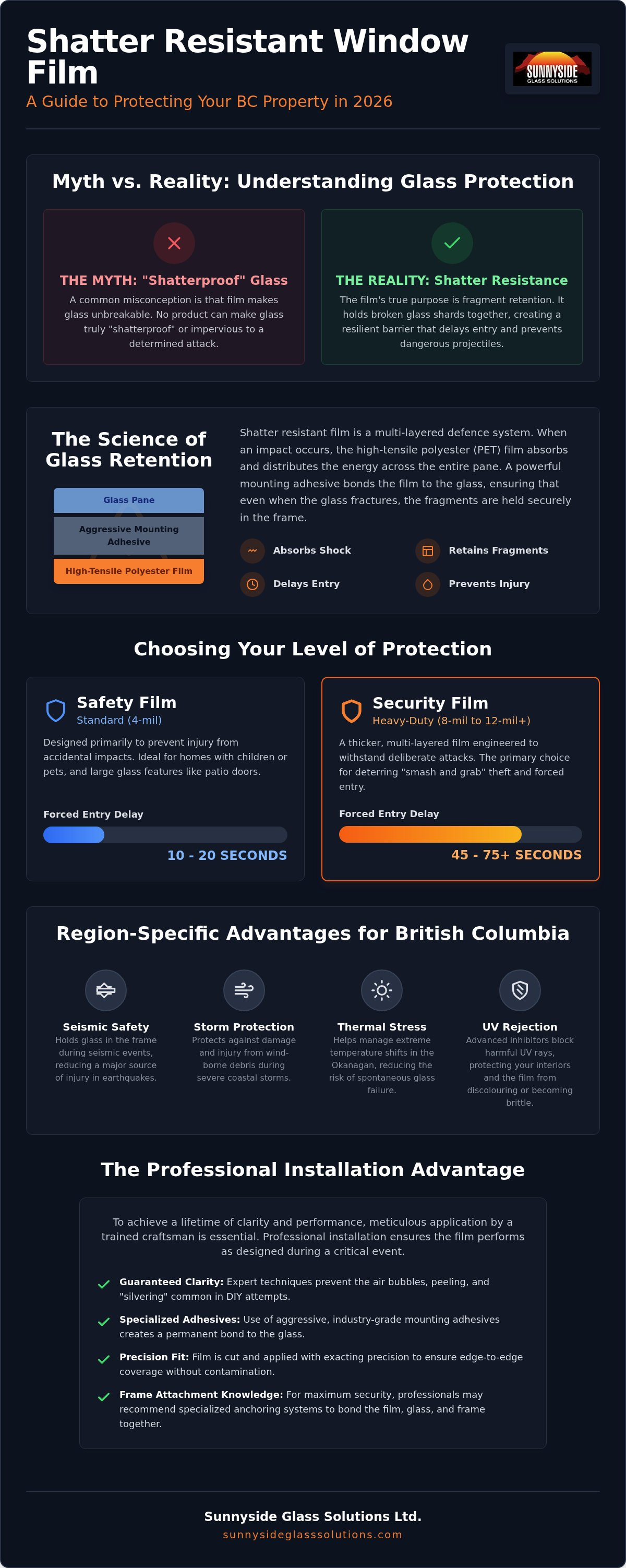
At its core, shatter resistant window film BC is a high-tensile polyester (PET) layer that we apply directly to your existing glass surfaces. This material is engineered to absorb energy from impacts, whether they originate from a stray golf ball in Kelowna or an attempted break-in at a Vancouver storefront. Shatter-resistant film is a safety laminate that holds glass shards together upon impact, preventing the dangerous spray of fragments that often causes the most significant injuries during a glass failure.
Understanding the technical capabilities of safety and security window film is essential for setting realistic expectations. A common misconception is that this product makes glass "shatterproof." In reality, no film can make glass completely unbreakable. The true objective is fragment retention and the delay of entry. By keeping the glass within the frame even after it breaks, the film creates a persistent physical barrier that forces an intruder to work much harder and louder to gain access; this often leads them to abandon the attempt entirely.
The Difference Between Safety Film and Security Film
While the terms are often used interchangeably, they represent different levels of protection. Safety film is typically thinner and focuses on preventing accidental injury. It's an excellent choice for Okanagan homes with large glass patio doors where children or pets might accidentally collide with the pane. Security film is a thicker, multi-layered version designed specifically to resist intentional "smash and grab" attacks. Choosing the right level depends on your specific goals. We often recommend thicker security grades for commercial street-fronts or residential entry points that are hidden from public view.
Common Misconceptions About Glass Protection
Many property owners worry that adding a protective layer will distort their view or change the aesthetic of their building. Modern high-quality films offer exceptional clarity, making them virtually invisible once the curing process is complete. You can enjoy your mountain or ocean views without the "jail cell" look of metal bars. Another frequent question is whether these films can be applied to double-pane, sealed window units. They absolutely can. If you have older windows with failing seals, we can even replace the sealed unit before applying the film to ensure your home remains energy efficient and secure. Remember, "shatterproof" is a marketing term used by some retailers, but as professional installers, we focus on the technical reality of shatter resistance and impact performance.
The Science of Glass Retention: How Security Film Protects Your Property
Understanding the mechanics of glass retention is essential to appreciating why these systems are so effective for property protection. To understand how security window film works, one must look at the aggressive mounting adhesives and the high-tensile polyester (PET) layers that bond to the glass surface. When a blunt force impact occurs, such as a strike from a brick or a baseball, the film acts as a shock absorber. It distributes the energy across the entire surface area of the pane, which prevents the glass from immediately collapsing. This "stretch and tear" resistance is what keeps the glass fragments contained within the frame, even after the structural integrity of the pane has been compromised.
The primary goal of installing shatter resistant window film BC is to create a significant delay for any potential intruder. Security professionals often discuss the "Three-Minute Rule," where the objective is to delay a breach long enough to discourage the attacker or allow for a response. According to 2026 industry data, a 4-mil security film can provide a 10 to 20 second delay against forced entry, while an 8-mil film can withstand a tool-based attack for 45 to 75 seconds. These seconds are precious. Most "smash and grab" thefts rely on speed; when the glass refuses to clear out of the way, the intruder typically moves on to an easier target.
The Impact of PET Technology on Glass Strength
Modern security laminates utilize a multi-layer construction that stacks thin sheets of polyester in alternating directions. This cross-weaving increases the overall tensile strength and prevents a single tear from spreading across the film. These films also include advanced UV inhibitors. These inhibitors are vital for the BC climate, as they protect the film from becoming brittle or discoloured due to sun exposure. If you're concerned about the current state of your windows, a professional assessment from Sunnyside Glass Solutions can determine if your existing units are suitable for this upgrade.
Annealed vs. Tempered Glass: Which Needs Film More?
Standard annealed glass is the most common type found in older BC homes, and it's also the most dangerous. When it fails, it breaks into large, razor-sharp shards that can cause severe injury. Shatter resistant window film BC is particularly effective here, as it can retain 80 to 90 percent of these fragments upon impact. Tempered glass, which is common in newer patio doors, breaks into small "popcorn" pieces. While safer, these pieces offer no resistance to an intruder once broken. For tempered glass, we often recommend an anchoring system that bonds the film to the window frame, ensuring the entire sheet of broken glass stays in place rather than falling out in a single clump.
Choosing the Right Thickness: 4-mil vs. 12-mil Security Films
When selecting shatter resistant window film BC, the most critical specification you'll encounter is the "mil" thickness. A "mil" is a professional unit of measurement equal to one one-thousandth of an inch. While this might sound microscopic, even a small increase in mil thickness significantly alters the performance of the laminate. Higher mil thickness directly increases the tear resistance of the product, but it also makes the material much stiffer. This rigidity requires specialized installation techniques and heavy-duty industrial tools to ensure the adhesive bonds perfectly to the glass without leaving unsightly air pockets.
Most property owners find that a 4-mil film is the ideal baseline for safety. It is thick enough to hold glass together during an accidental impact or a basic smash-and-grab attempt, yet it remains flexible enough for a clean, clear finish on standard residential windows. For high-value commercial properties or street-front retail spaces, we often move into the 8-mil to 12-mil range. These heavy-duty films provide the robust barrier needed to withstand prolonged attacks with heavy tools, though they must be carefully matched to the structural weight limits of your existing window frames.
Residential vs. Commercial Grade Applications
For an Okanagan home, 4-mil film is typically the standard choice for patio doors and low-level windows where children or pets are most active. It provides essential peace of mind without over-stressing the glass units. Conversely, Kelowna storefronts or Vancouver office complexes often require the added security of 8-mil or 12-mil films. Unlike some misleading retail claims that suggest thick films are easy to handle, 12-mil material behaves more like a sheet of flexible plexiglass. It requires significant pressure and professional-grade squeegees to activate the mounting adhesive and achieve a factory-quality finish.
Tinted Security Film: Combining Privacy with Protection
Many of our clients choose to combine their security needs with solar control. Tinted security films offer a "one-way" privacy effect that prevents outsiders from casing your property while simultaneously strengthening the glass against intrusion. This dual-purpose approach is particularly effective in the BC interior, where reducing solar heat gain is just as important as physical security. If your primary concern is managing the intense summer sun while protecting your interiors, you can learn more about these options in our guide to solar window film for homes. By choosing a tinted security laminate, you improve the efficiency of your building and the safety of your occupants in a single professional application.
BC-Specific Benefits: From Seismic Safety to Storm Protection
Living in British Columbia means preparing for environmental risks that vary significantly by region. Whether you're managing a commercial high-rise in Vancouver or a lakeside home in the Okanagan, standard glass is often the most vulnerable part of your building's exterior. Integrating shatter resistant window film BC into your property maintenance plan addresses these local threats by transforming a fragile surface into a reinforced safety barrier that performs under pressure.
Seismic Safety in British Columbia
The Lower Mainland and Coastal regions sit within a seismically active zone where the risk of ground movement is a constant consideration. During an earthquake, building frames often shift and flex, which places immense pressure on rigid glass panes. This stress can lead to "spalling," where glass fragments explode outward. Professionally certified fragment retention systems, typically using 4-mil thick film, have undergone rigorous testing at the University of British Columbia's earthquake laboratory to ensure they can hold glass in place during such events. This protection is vital for high-rises and residential homes alike, as it prevents shards from falling onto streets or into interior living spaces, significantly reducing post-disaster injury risks.
Storm and Wind Protection in the Okanagan
In the Interior, the primary environmental threats shift toward high-wind storms and extreme thermal stress. Windstorms in Summerland and Peachland can easily turn garden debris into dangerous projectiles. If a branch strikes your window, the film absorbs the impact and prevents the pane from collapsing into your home. Large skylights in Kelowna are particularly prone to damage from hail or falling debris. If you notice signs of wear or seal failure, it might be time for a skylight glass replacement or a protective film upgrade to ensure your overhead glass remains secure during a storm.
We must also consider the "wildfire factor" that impacts many BC communities. During extreme heat events, glass can fail due to thermal stress or proximity to exterior flames. While window film isn't fireproof, it helps the glass remain intact within its frame for a longer duration. This helps maintain the building's envelope and can prevent wind-blown embers from entering the structure through a shattered opening. If you want to reinforce your home against these local challenges, you can request a professional security film assessment from Sunnyside Glass Solutions to identify the best protection for your specific location.
Professional Installation in BC: Why Precision Matters
While some internet tutorials suggest that applying security film is a simple weekend project, the reality of working with heavy-gauge shatter resistant window film BC is far more demanding. Thick polyester laminates are notoriously rigid and difficult to manipulate. Without the correct technique, DIY attempts frequently result in "silvering," which is a hazy, unattractive appearance caused by microscopic air pockets or trapped moisture between the glass and the adhesive. To achieve a factory-clear finish, our technicians utilize industrial-grade squeegees and high-pressure application methods that a standard hand tool simply cannot replicate.
For high-security applications, the professional secret lies in the anchoring system. While a standard "daylight" fit covers the visible glass, a true security installation often requires bonding the film directly to the window frame using a specialized structural silicone. This ensures that even if the glass is completely smashed, the entire reinforced pane remains locked within the frame. This level of precision is especially critical for commercial storefronts and residential entry points where forced entry is a primary concern. Most heavy films also require the controlled use of industrial heat guns to ensure the material contours perfectly to the glass surface without peeling at the edges.
The Sunnyside Glass Solutions Advantage
With over 25 years of experience serving communities from Penticton to Vancouver, we understand the specific needs of BC property owners. One of our most significant advantages is our ability to provide sealed window unit replacement alongside our film services. If your existing windows have failed seals or internal fogging, we can replace the glass units before applying the security film. This comprehensive approach ensures that your windows are not only safe but also visually clear and energy efficient, providing a level of service that a simple film-only installer cannot offer.
What to Expect During Your Installation
A successful installation begins with surgical-level glass preparation. We remove every trace of dust and debris, as even a single hair can compromise the adhesive bond. Our team performs precision cutting to ensure the film sits perfectly against the window gaskets with no visible gaps. Once applied, the film requires a curing period to reach its full rated strength. While the glass is immediately safer, the moisture used during installation can take several days or weeks to fully evaporate, depending on local humidity levels in the Okanagan or the Coast. This methodical, patient process guarantees the longevity and performance that our clients have relied on for decades.
Securing Your Property with Long-Term Confidence
Choosing to install shatter resistant window film BC is a proactive step toward protecting your most valuable assets from both intentional threats and environmental risks. The effectiveness of these systems relies on selecting the appropriate thickness for your specific environment and ensuring a flawless bond between the film and the glass. By prioritizing high-performance materials and professional-grade retention systems, you gain a resilient barrier that maintains the aesthetic clarity of your windows while significantly delaying potential intruders or containing hazardous shards during a seismic event.
Sunnyside Glass Solutions provides the stability of over 25 years of local experience, serving residential and commercial clients from the Okanagan to Vancouver. We specialize in high-performance security films and comprehensive glass services, ensuring your property remains a safe environment for years to come. Our meticulous approach to installation guarantees that your protection is as durable as it is invisible. To take the next step in reinforcing your building's perimeter, request a free security film estimate from Sunnyside Glass. We look forward to helping you achieve lasting peace of mind through expert craftsmanship and reliable results.
Frequently Asked Questions
Is shatter resistant window film the same as bulletproof glass?
No, shatter-resistant film is not the same as bulletproof glass. While these films provide significant protection against impacts and forced entry, they are not designed to stop ballistic projectiles. Bullet-resistant systems usually involve multiple layers of thick polycarbonate or specialized architectural glass. Our security films focus on keeping glass shards contained within the frame to protect your family from injury and to delay intruders during a "smash and grab" attempt.
Can I install security film on my existing double-pane windows in BC?
Yes, you can install security film on existing double-pane windows. It is a highly effective retrofit solution for homes in Kelowna or offices in Vancouver. However, if your windows currently have fogging or failed seals, we recommend a sealed window unit replacement before the film application. Applying film to a compromised unit won't fix the underlying seal failure, but installing it on a healthy pane provides immediate security and safety benefits.
How long does professional shatter resistant film last?
High-quality shatter resistant window film BC typically lasts between 10 and 15 years when professionally installed. The lifespan depends on factors like sun exposure and the quality of the initial application. Because we utilize precise installation techniques and industrial-grade adhesives, our films maintain their clarity and protective properties for the long term. Proper maintenance, such as using non-abrasive cleaning tools, will help ensure your film remains effective and clear throughout its service life.
Will security film make my home windows look dark or reflective?
Standard security film is virtually invisible and will not make your home windows look dark or reflective. It is designed to maintain the natural light and architectural aesthetic of your property. If you also require privacy or heat reduction, we offer tinted options that provide those benefits alongside security. For most residential clients in the Okanagan, a clear film is the preferred choice because it provides peace of mind without altering the view.
Does window film prevent the glass from breaking during a break-in?
Window film does not prevent the glass from breaking, but it does prevent the glass from falling out of the frame. When an intruder strikes the pane, the glass will crack, but the high-tensile polyester layer holds the fragments together. This creates a persistent physical barrier that is difficult to penetrate. By keeping the window intact, the film prevents easy access to your home and forces the intruder to spend more time attempting a breach.
Can shatter resistant film help with heat reduction in the Okanagan?
Yes, many of our security films are multi-functional and include solar control properties. In regions like Peachland and Summerland, where summer heat is intense, these films can block up to 99 percent of UV rays and significantly reduce solar heat gain. This dual-purpose approach improves the comfort of your living space while protecting your interiors from fading. It is a practical way to combine property security with improved energy efficiency for your Okanagan home.
Is it possible to remove the film later if I change my mind?
It is possible to remove window film later, though we recommend having it done by a professional to avoid damaging the glass surface. The removal process involves specialized tools and solutions to dissolve the aggressive mounting adhesive. Once the film is removed, the glass underneath will be in its original condition. This flexibility makes it a great option for both permanent residences and commercial storefronts that may undergo future renovations or changes in security needs.
What is the cost difference between 4-mil and 8-mil film installation?
The cost of 8-mil film is generally higher than 4-mil film due to the increased material thickness and the specialized labour required for installation. Thicker films are more difficult to handle and require industrial tools to ensure a perfect bond. While 4-mil film is sufficient for basic safety and seismic protection, the 8-mil option provides significantly more resistance against forced entry. We can help you determine which thickness provides the best value for your specific security goals.


Comments