
The Okanagan Buyer’s Guide to Energy Efficient Window Film in 2026

What if the secret to a cooler, more comfortable home this summer isn't a massive renovation project, but a precision upgrade to the glass you already own? Most Okanagan homeowners realize that the intense valley sun is the primary cause of soaring cooling costs and faded flooring, yet many believe the only solution is a costly, full window frame replacement. It's a frustrating situation when your frames are perfectly sound, but your rooms still feel like ovens by mid-afternoon.
This guide will show you how to lower your utility bills and preserve your home's interior aesthetics using professional-grade energy efficient window film. By focusing on the performance of the glass itself, you can reject up to 79 percent of solar heat without the expense or disruption of a total overhaul. We'll break down the latest 2026 film technologies, explain the critical differences between film and replacement regarding rebate eligibility, and help you choose the right solution for your specific needs. You'll discover how a meticulous, expert installation can provide the long-term protection and clarity your home deserves.
Table of Contents
Understanding Solar Heat Gain in the Okanagan Climate
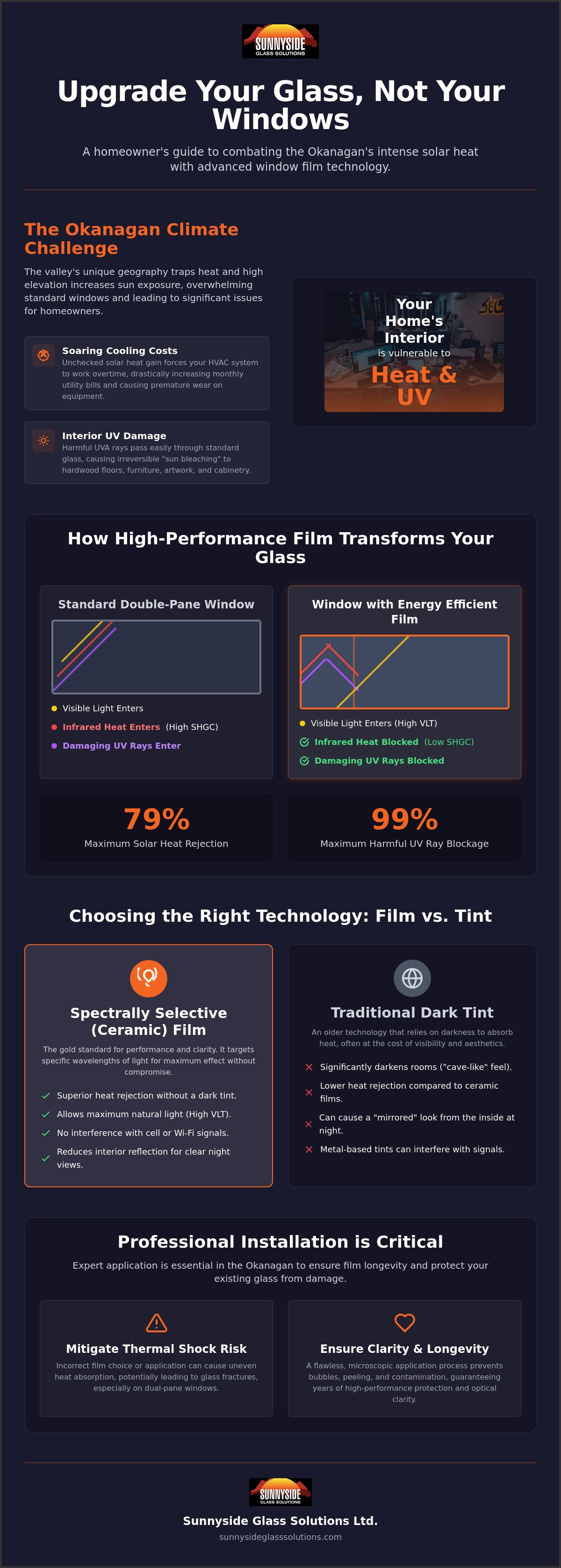
Living in the Okanagan offers stunning views and world-class summers, but these benefits come with a significant environmental tax: intense solar radiation. The valley's unique geography traps heat, while our high elevation increases UV exposure compared to coastal regions. Standard double-pane windows often don't manage this energy load well, especially during the punishing afternoon sun. This is where Understanding Window Film technology becomes essential for local homeowners. High-performance energy efficient window film is a sophisticated, multi-layered polyester coating designed to surgically reflect and absorb solar energy before it penetrates your living space. These layers are engineered to target specific parts of the light spectrum, ensuring you keep your view while rejecting the heat.
The Science of Solar Heat Gain
When sunlight hits your glass, it isn't just light entering your home; it's radiant heat. This energy passes through the pane and is absorbed by your carpets, walls, and furniture, which then radiate that heat back into the room. This process is measured by the Solar Heat Gain Coefficient (SHGC). A window's SHGC represents the fraction of solar radiation admitted through the glass. In our climate, a lower SHGC is vital for maintaining a comfortable interior. If your windows have a high SHGC, your HVAC system must work overtime to combat the constant influx of heat. This leads to increased wear and tear on your equipment, potentially shortening the lifespan of expensive air conditioning units while driving up monthly utility costs. A well-chosen film can reduce this coefficient significantly without the need for a full window replacement.
UV Damage: More Than Just Heat
While heat is the most immediate discomfort, UV radiation is a silent threat to your home's interior. The intense Okanagan sun can quickly degrade expensive hardwood floors, leather upholstery, and custom cabinetry. Traditional glass blocks some UVB rays, but UVA rays, which cause the most significant fading, pass through easily. Professional energy efficient window film acts as a powerful barrier, blocking up to 99 percent of these harmful rays. This protection provides several key benefits:
Preservation of interior finishes, preventing the "sun bleaching" often seen near large windows.
Extended life for artwork and photographs that are sensitive to light exposure.
Reduced health risks associated with prolonged UV exposure while sitting near windows.
Lowered interior temperatures, which helps your cooling system maintain a steady, comfortable environment.
By addressing both the heat and the light spectrum, these films transform your existing windows into high-performance shields. This upgrade is particularly critical for west-facing views where the late-day sun is most aggressive. Instead of closing the blinds and living in the dark, you can maintain your connection to the beautiful Okanagan landscape while keeping your home's interior cool and protected.
How High-Performance Window Films Work
Modern window film has evolved far beyond the dark, bubbly tints of the past. Today's high-performance energy efficient window film utilizes spectrally selective technology to distinguish between different wavelengths of the solar spectrum. This allows the film to block the infrared radiation responsible for heat while permitting the majority of visible light to enter your home. This balance is measured as Visible Light Transmittance (VLT). A high VLT means your rooms remain bright and airy, while a low Solar Heat Gain Coefficient ensures the heat stays outside where it belongs. This technology allows you to protect your home without changing its architectural character or losing your connection to the outdoors.
Spectrally Selective vs. Traditional Tint
Many homeowners mistakenly believe that a darker film provides better cooling. In reality, modern ceramic films offer superior heat rejection without the cave-like feel of traditional dark tints. Ceramic films are often considered the gold standard because they don't contain dyes or metals that can corrode or interfere with electronic signals. They also maintain your Okanagan view at night by reducing interior reflectivity. This ensures you can still see the evening lights of Kelowna or Penticton without seeing a mirror image of your living room reflected in the glass. It's a sophisticated solution that prioritizes clarity alongside performance.
Winter Benefits: Retaining Radiant Heat
While solar rejection is the priority during our hot summers, the latest Low-E (Low Emissivity) films provide significant value when the temperature drops. These films are designed to change the emissivity of the glass surface, helping to retain radiant heat inside your home. Detailed studies on how low-e window films work demonstrate that they can effectively give older single-pane or standard double-pane units the thermal performance of more expensive, modern windows. In the Okanagan, where winter nights can be biting, these films can reflect up to 35 percent of your indoor heat back into the room. This reduction in heat loss helps eliminate that drafty feeling near large glass areas and can lead to a noticeable decrease in your heating costs.
Selecting the right film involves balancing aesthetics, summer rejection, and winter insulation. If you're unsure which technology fits your specific windows, consulting with a local glass specialist can help you identify the most cost-effective upgrade for your property. This professional guidance ensures that the film you choose addresses your home's unique orientation and your specific comfort goals.
Film vs. Sealed Unit Replacement: Which Upgrade Do You Need?
Choosing the right upgrade for your Okanagan home requires a clear understanding of your windows' current condition. While energy efficient window film is an exceptional solution for reducing heat and UV damage, it is designed to enhance functional glass, not to repair structural failures. If you are noticing a persistent hazy appearance or moisture trapped between your double-pane windows, the issue is likely a compromised seal rather than just poor solar performance. Applying film to a window with a failed seal is a mistake; the moisture will remain trapped, and the film may even exacerbate the visual distortion. It's a waste of resources to film glass that has already lost its structural integrity.
Signs of a Blown Window Seal
A blown seal is usually easy to self-diagnose. If you see condensation or "fog" between the glass panes that cannot be wiped away from either the inside or the outside, the desiccant inside the spacer bar is saturated. This failure destroys the window's R-value, as the insulating gas has escaped and been replaced by moist air. In the Okanagan, extreme temperature swings accelerate this "solar pumping" effect, eventually leading to permanent mineral deposits on the glass. In these instances, sealed window unit replacement is the only effective remedy to restore clarity and thermal efficiency to your home.
Cost and Performance Comparison
Many homeowners fear that a failed window means they must endure the mess and expense of tearing out the entire frame. This is rarely the case. By focusing on replacing only the glass unit, you can achieve the performance of a brand-new window at a fraction of the cost. This approach preserves your existing trim and siding while providing a fresh, high-performance sealed unit that fits perfectly into your original frame. It's a surgically precise fix that avoids the labour-intensive process of a full renovation.
For homes with a mix of issues, a "Hybrid Approach" often provides the best return on investment. You might choose to replace the failed glass units in your living room and then apply energy efficient window film to the remaining structurally sound windows. This strategy allows you to:
Restore clarity to foggy views without the cost of full frame replacement.
Uniformly upgrade the heat rejection across the entire facade of your home.
Address specific hot spots while maintaining a consistent interior aesthetic.
Maximize your budget by only replacing glass where it is absolutely necessary.
Sunnyside Glass Solutions leverages over 25 years of local experience to help you identify which windows are candidates for film and which require a new sealed unit. We prioritize professional craftsmanship and practical fixes that improve your home's comfort without unnecessary expenditures. Our goal is to provide a reliable, long-lasting solution that respects your budget and your property's aesthetic value.
Choosing the Right Film for Your Home's Orientation
Not every window in your home requires the same level of intervention. A one-size-fits-all approach often leads to unnecessarily dark north-facing rooms or under-protected west-facing sunrooms. To maximize the performance of your energy efficient window film, you must consider the sun's path across your property. While west-facing glass takes the brunt of the afternoon heat, north-facing windows still benefit from UV protection without needing heavy solar rejection. Balancing these needs ensures your home remains comfortable and bright while maintaining a consistent exterior appearance across all elevations.
The West-Coast Heat Challenge
The late afternoon sun is the primary driver of cooling costs in the Okanagan. Between 3:00 PM and 7:00 PM, west-facing windows can turn a living room into a furnace as radiant energy pours through the glass. For these specific areas, we recommend films with the highest Solar Heat Gain Coefficient (SHGC) reduction. This targeted application helps your air conditioner maintain a steady temperature without working overtime during the hottest part of the day. Beyond heat, these specialized films significantly reduce the blinding glare that often makes watching television or working on a computer screen nearly impossible during the golden hour. It allows you to reclaim your living space without being forced to sit in the dark behind heavy drapes.
Privacy and Security Hybrids
For glass that faces the street or sits near entryways, you can combine thermal performance with security film installation. These thicker, multi-layered films are designed to hold glass shards together upon impact, which effectively deters smash-and-grab entries. It's a practical way to enhance your home's safety while still enjoying the benefits of energy efficient window film. In bathrooms or foyers, frosted or mirrored options provide necessary privacy during the day without the need for dust-collecting blinds or curtains. This ensures your home remains private and secure while still benefiting from improved thermal insulation.
Achieving a uniform look across your home's exterior is a hallmark of professional craftsmanship. You don't want your property to look like a patchwork of different shades and finishes. By selecting a coordinated suite of films, you can address specific heat issues on the west side while maintaining a clear, natural look on the north side. If you're ready to see how these different options look on your specific glass, request a professional assessment from our Okanagan team to find the perfect balance of performance and aesthetics for your home.
The Importance of Professional Installation in the Okanagan
The performance of any energy efficient window film is only as good as the surface preparation and the precision of the application. While DIY kits might seem like a cost-saving measure, the Okanagan's extreme temperature fluctuations create unique risks that generic kits simply cannot handle. One of the most significant dangers is thermal shock. If an incompatible film is applied to certain types of double-pane glass, it can cause the unit to absorb too much heat, leading to stress cracks or even total glass failure. A professional installer understands the technical specifications of your existing glass and ensures the chosen film is safely compatible with your specific window units.
Professional application also secures your investment through manufacturer warranties. Most high-performance film manufacturers will only honour their 15 to 20-year warranties if the product is installed by a certified dealer. This protection is vital because it covers issues like adhesive failure, bubbling, or delamination that might occur years down the road. When you choose an expert, you aren't just paying for the film; you're buying the peace of mind that comes from a durable, guaranteed result that preserves the clarity of your view.
Avoiding the 'DIY Bubble' and Peeling
The difference between a professional finish and a DIY attempt is often found in the environment and the adhesives used. Our technicians employ a meticulous, multi-stage cleaning process to ensure the glass is surgically clean before the film is even unpacked. This prevents the unsightly dust nibs and bubbles that characterize home-applied tints. We use industrial-grade adhesives that are designed to withstand the intense UV indices of our valley summers without peeling or discolouring. While government rebates in BC currently focus on full replacements, the true return on investment for a film upgrade is found in the immediate reduction of cooling costs. This outcome is only possible with a flawless application that maintains its integrity for decades.
Sunnyside's Commitment to Quality
With over 25 years of local experience serving homeowners from Kelowna to Osoyoos and Penticton, Sunnyside Glass Solutions understands the specific environmental demands of the Okanagan. We take a holistic approach to your home's comfort, which is why we are uniquely positioned to handle both film application and window film residential upgrades. Our expertise allows us to identify when a window is a perfect candidate for a solar upgrade and when it might require a new sealed unit instead. This honest, service-oriented approach ensures you never spend money on a fix that won't last.
Realizing the energy savings and comfort improvements discussed in this guide starts with a professional assessment of your current glass. Our team provides a steady, methodical evaluation of your home's orientation and thermal needs to help you choose the most effective solution. By focusing on professional craftsmanship and long-lasting results, we help you protect your interior and lower your cooling costs for years to come. Your next step toward a more efficient home is booking a consultation to see how we can optimize your existing windows without the disruption of a full renovation.
Optimizing Your Okanagan Home for 2026 and Beyond
Choosing the right balance of solar rejection and thermal insulation ensures your home remains a sanctuary during our intense valley summers. We've seen how modern technology allows you to reject the heat while keeping your view, and how a targeted approach to home orientation maximizes your return on investment. By prioritizing professional installation, you avoid the risks of thermal shock and ensure your glass performs at its peak for decades. It's clear that high-quality energy efficient window film offers a sophisticated, frame-preserving alternative to full window replacement that respects both your budget and your home's aesthetic.
Sunnyside Glass Solutions brings over 25 years of local expertise to every project. We specialize in frame-preserving glass upgrades and provide reliable service from Kelowna and Penticton to the entire Valley. Our team is ready to help you identify the most effective path toward lower energy bills and improved interior comfort. Request a Professional Consultation with Sunnyside Glass Solutions today to start your home's transformation. You'll enjoy a cooler, more protected environment while knowing your property is in the hands of seasoned experts.
Frequently Asked Questions
Does energy efficient window film really work in the summer?
Yes, high-performance films are specifically engineered to reject solar heat before it enters your living space. By reflecting and absorbing infrared radiation, these advanced coatings can deflect up to 79 percent of solar heat. This significantly reduces the load on your air conditioning system and eliminates the uncomfortable hot spots often found in rooms with large, west-facing windows.
Will window film cause my double-pane windows to crack?
Thermal shock cracks are a rare but real risk if an incompatible film is applied to certain types of glass units. Professional installers prevent this by conducting a technical assessment of your windows to ensure the film's heat absorption levels match the glass's structural strength. Certified installations also include manufacturer warranties that protect against this specific issue, which is a major advantage over DIY projects.
Can I install window film over a foggy or blown window seal?
No, applying film to a window with a failed seal is not recommended and will not resolve the structural failure. Moisture trapped between the panes will remain visible, and the film may actually highlight the hazy distortion. In these instances, the failed glass unit should be replaced first to restore clarity and thermal performance before any solar film is applied to the surface.
How long does professional window film installation take?
Most residential projects are completed within a single day. A standard room typically takes two to three hours, while a full house may require a full working day depending on the number of panes. Because the process involves precision cutting and a specialized wet application, the film requires a curing period of several weeks to fully bond and achieve maximum clarity.
Does window film help with winter heat loss in Canada?
Yes, certain varieties of energy efficient window film are designed with low-emissivity properties that help retain indoor heat during the winter. These specialized coatings can reflect up to 35 percent of your home's radiant heat back into the room. This helps eliminate the drafty feeling near windows and reduces the energy required to maintain a comfortable temperature during cold Okanagan nights.
Will solar film make my house too dark inside?
Modern spectrally selective films are designed to block heat without significantly darkening your interior. You can choose products with a high Visible Light Transmittance (VLT) that appear virtually invisible once they are installed. This allows you to maintain your natural light and Okanagan views while still achieving substantial heat rejection. We help you find the perfect balance between aesthetic clarity and thermal performance.
Is there a rebate for installing energy efficient window film in BC?
As of 2026, government rebates from CleanBC and FortisBC are typically reserved for full window replacements rather than aftermarket film installations. To qualify for these incentives, windows must meet specific U-factor requirements through complete unit upgrades. However, the lower upfront cost of energy efficient window film compared to full replacement often provides a faster return on investment through immediate monthly energy savings.
How do I clean my windows after film has been installed?
You should wait at least thirty days after installation before cleaning your filmed windows to allow the adhesive to cure fully. Once cured, use a soft cloth or clean synthetic sponge with a mild, ammonia-free detergent. Avoid using abrasive pads, scrapers, or harsh chemicals that could scratch the protective hard coat. Regular, gentle maintenance will preserve the film's clarity and performance for over twenty years.


Comments