
UV filtering film for art galleries Summerland: Film life and lifespan

UV film is a protective layer, not a permanent one. For galleries in Summerland, choosing UV filtering film for art galleries means planning for eventual replacement: one museum reported a replacement interval of 10-15 years. Exposure and glass condition affect how long film remains in good shape, and scratches or haze can signal visible wear.
Protecting artwork from daylight matters, but historic or irregular glass can make film removal more complex if solvents or scraping are required. This guide explains how film degrades, what to consider before treating heritage windows, and how to compare samples and specifications. You’ll also learn how UV protection differs from visible-light control, helping you assess UV filtering film for art galleries in Summerland in the context of your space and collection.
Table of Contents
Film lifespan and degradation
UV film has a finite service life, so galleries should plan for eventual replacement rather than assume one installation will protect collections indefinitely. One museum reported that its window film should be replaced after 10-15 years. Treat this as a planning reference, not a fixed expiry date for every window: exposure, installation conditions, and the film’s visible condition all matter. In Summerland, the practical question is whether the installed film remains clear and intact while serving the gallery’s light-management needs.
Outdoor installations can age differently from film applied indoors. A museum professional estimated that outdoor acrylic panels and film would last about seven years, while materials lasted ten years at a seaside location. These examples show why one lifespan figure cannot describe every installation. Indoor application can extend film life, but glazing, surroundings, and exposure still affect performance. Consider the setting of each window when planning gallery inspections and replacement.
Degradation may show up as scratches or a hazy appearance. These changes affect the surface and can make a window look less clear, so include film condition in routine checks of gallery glazing. Cleaning matters too: review the film’s care precautions before choosing products or methods. Abrasive contact can scratch film, while unsuitable cleaning can affect its appearance. Pay particular attention to marked or hazy areas where visitors view artwork through the glass.
For replacement planning, record the installation date and note changes in clarity or surface condition. Compare the current appearance with the original installation, and review the manufacturer’s care guidance before cleaning. If the film approaches the reported 10-15-year replacement period, plan an assessment rather than waiting for severe visible wear. Clear appearance alone doesn’t establish the film’s UV performance, so replacement decisions should consider both condition and documented specifications. This approach helps galleries plan maintenance while avoiding assumptions based only on age.
Risks of installing film on historical glass
UV film filters some ultraviolet radiation reaching artwork, but it does not remove every light-related risk. It is not accurate to conclude that film damages every insulated glass unit; the glass and film must be considered together. With historic or irregular glass, the specific concern is that removal may require solvents or scraping, putting the glass surface at risk.
This removal concern matters in heritage buildings, where original glazing may have uneven surfaces or historic value. Film can adhere differently to irregular glass, and later removal may be more difficult than from a modern, uniform pane. Before considering film for a gallery or historic house, identify which windows are original, irregular, or otherwise sensitive. This helps determine whether film is suitable or another filtering method better fits the window.
UV-filtering glass offers a different approach: the filtering material is part of the glazing rather than an applied layer. In measurements reported by the Canadian Conservation Institute, museum-targeted UV-filter glass reduced UV by an average of 83% ± 14%. That result describes the tested glass, not every product or installation. Existing historic glazing may also be difficult to replace without changing the building’s character.
Rigid acrylic panels provide another option for some settings. ASTM D4802-10 requires acrylic sheet with UV absorbers to cut at least 95% of UV radiation in the 200-390 nm range. A panel can be considered where an applied film presents removal concerns, but it changes the window assembly and may affect its appearance. For a gallery with original glass, compare the preservation impact of film, replacement glazing, and a separate panel before choosing.
For insulated glass, match the proposed film to the specific glazing rather than assuming one film suits every unit. A careful assessment should distinguish heritage glass from later sealed units and identify whether access for removal is limited. This helps balance UV filtering with the condition and preservation of each window.
Choosing film samples and specifications
Compare UV performance with visible-light transmission and appearance. A sample shows how a film may look against the gallery’s glazing.
Comparing UV film samples with a professional
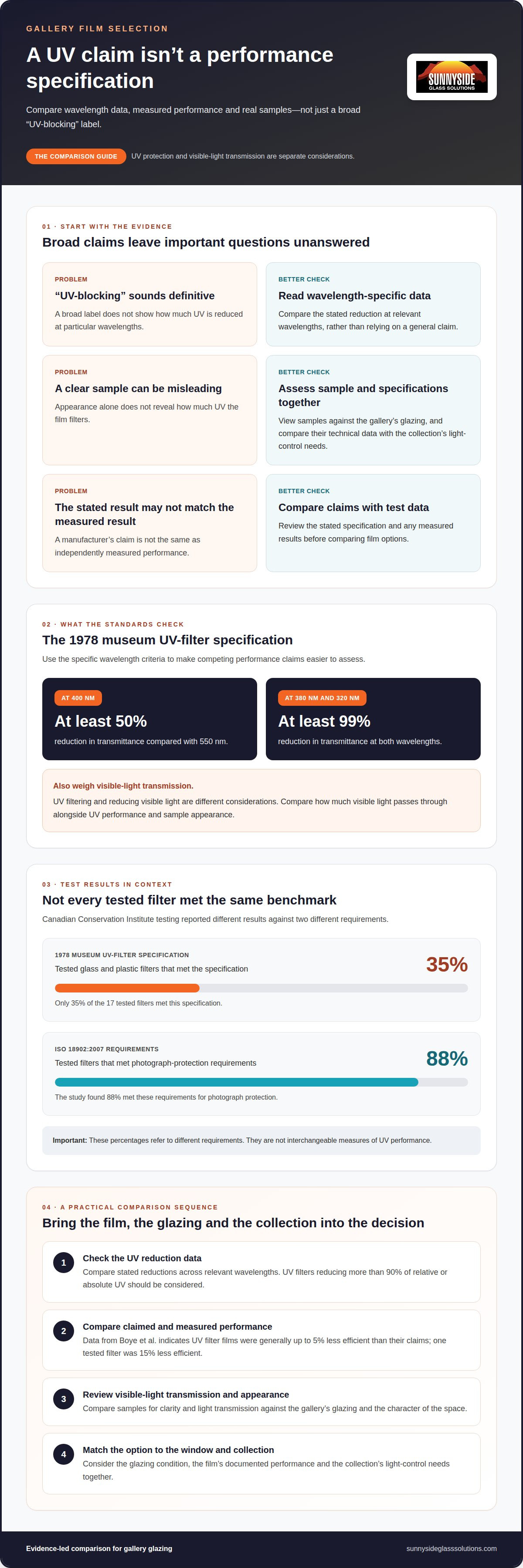
A professional compares samples by matching their technical specifications to the gallery’s light-control needs. This matters because a clear-looking sample doesn’t reveal how much UV it filters. The 1978 museum UV-filter specification calls for at least a 50% reduction in transmittance at 400 nm compared with 550 nm, and at least 99% reduction at 380 nm and 320 nm. These wavelength-specific details make competing claims easier to assess.
UV Protection Levels
Gallery films vary in UV performance, so compare the stated reduction across relevant wavelengths. UV filters that reduce more than 90% of relative or absolute UV should be considered. The Canadian Conservation Institute found that only 35% of 17 tested glass and plastic filters met the 1978 museum specification. Its study also found 88% met ISO 18902:2007 requirements for photograph protection. These results show why a broad “UV-blocking” label isn’t enough.
Performance claims also deserve careful comparison. Data from Boye et al. indicates that UV filter films were generally up to 5% less efficient than their claims; one tested filter was 15% less efficient. A professional can assess the specification and sample together, while noting the difference between claimed and measured performance. This helps galleries compare documented protection rather than relying on appearance alone.
Professional film selection and installation
Professional selection and installation match the film to the glazing, collection needs, and desired appearance. A professional considers the window’s condition, the film’s stated UV performance, and how much visible light should pass through. Careful, even application affects the finished appearance. The specification, existing glass, and workmanship all contribute to the result at each gallery window.
For a practical comparison, review wavelength-specific performance, visible-light transmission, and how samples look against the actual glazing. A sample can clarify colour and clarity, while its technical information explains the protection it claims to provide. Together, these details help galleries choose film based on conservation priorities and the character of the space.
UV window film for galleries and historic houses
Galleries and historic houses in Summerland balance collection protection with the character and condition of their windows. Daylight can be 10-13 times more reactive than light from a tungsten lamp of the same intensity, so UV filtering is one part of a broader light-control plan. The key is distinguishing UV protection from reductions in visible light, heat, or glare. Choosing UV filtering film for art galleries in Summerland means weighing those goals against each room’s glazing and collection.
For a heritage property, establish the building’s heritage status and whether film would change the visible character of its historic glazing. These details help guide local review questions; commercial use alone does not identify which considerations apply. Original glass, irregular surfaces, and preservation goals also affect whether applied film is suitable.
UV film can reduce ultraviolet transmission, but its UV rating alone does not show how much heat or glare it will reduce. Those outcomes depend on other performance characteristics, including visible-light and solar transmission. If a gallery needs consistent UV filtering while controlling bright daylight, assess these goals separately rather than assuming one UV specification addresses both.
A 2010 report found that UV window films offered a reduction of 96% ± 2% in the 300-400 nm range. That figure describes reported film performance in that range; it doesn’t state how much visible light the film blocks. For collection planning, compare UV performance with the desired brightness in each room, then consider supplementary visible-light controls where needed.
Historic-house experience also shows why planning should account for replacement and appearance. One historic house museum replaced UV window film that had been in place for over 20 years. That example shows a long service period is possible, but it shouldn’t be treated as a lifespan promise for other buildings. Film condition, window type, and preservation priorities still shape the decision.
A professional assessment of UV filtering film for art galleries in Summerland can consider the glazing and the project’s light-control goals. Window film installation can align film selection and application with those needs.
Sunnyside Glass Solutions
Sunnyside Glass Solutions Ltd. provides professional window film installation for galleries and property owners seeking UV protection. When historic glazing, film condition, or visible-light needs affect the decision, discuss the windows and intended outcome before planning the work. If a sealed window unit needs replacement rather than film, Sunnyside also provides that service. The right choice depends on the glazing and the building’s priorities, especially when preserving original glass matters.
For a gallery project, share which windows are involved, whether the glass is historic or irregular, and what protection or appearance you want. These details help shape an installation around the property’s needs. Contact Sunnyside Glass Solutions Ltd. to discuss your window film project.
Plan the next step for your gallery windows
Before choosing a film, define what matters most in each space: protecting a collection, preserving the look of historic glazing, or controlling daylight without making the room feel dim. For UV filtering film for art galleries in Summerland, this gives a professional a clear starting point for matching the window, film specification, and gallery priorities. Note which windows are original or irregular, and where sealed units may need a different solution.
Sunnyside Glass Solutions offers window film installation and sealed window unit replacement, helping address different glazing needs as part of a considered project. If you’re ready to discuss your gallery’s windows and protection goals, contact Sunnyside Glass Solutions. A clear plan can make the next decision more straightforward and help you move ahead with confidence.
Frequently Asked Questions
What UV-filtering window film options suit art galleries?
Gallery options include clear UV-filtering film and film designed to reduce visible light as well. For an art gallery in Summerland, the choice depends on whether the priority is preserving natural brightness, limiting incoming light, or balancing both. Compare the film’s stated UV performance with its effect on visible light, since UV protection alone does not describe the room’s final appearance.
How do visible light transmission and colour neutrality vary?
Visible-light transmission describes how much visible light passes through the glazing and film; colour neutrality describes whether the view appears tinted. Some clear self-adhesive films are described as having no noticeable tint after installation, but that should not be assumed for every film. A physical sample against the gallery’s own glazing can reveal changes in colour and brightness more clearly than product wording alone.
Are UV film installation services available near Summerland, British Columbia?
Yes. Sunnyside Glass Solutions Ltd. provides window film installation in Summerland and serves Penticton, Kelowna, Peachland, West Kelowna, and Vancouver. A gallery project can start with the specific windows and the collection’s protection needs. This helps distinguish an installation suited to modern glazing from a situation involving historic or irregular glass.
How long does UV window film last, and what is the warranty?
Film life depends on the installation and its exposure, so age alone does not show whether it remains in suitable condition. Watch for changes such as scratches or reduced clarity, and keep the product’s care and warranty documents with building maintenance records. Warranty coverage is product-specific; a UV-performance claim is not a warranty term or a guarantee of service life.
How does UV window film compare with UV-filtering acrylic glazing for artwork?
Film adheres to existing glazing, while acrylic glazing is a separate rigid panel that can serve as another filtering layer. The practical difference is how each option interacts with the existing window: a panel avoids applying film directly, while film stays closer to the glass. For a historic display window, compare appearance, mounting approach, and future removal needs before choosing either option.
Where can I buy UV-filtering film in the Okanagan?
Sunnyside Glass Solutions Ltd. supplies and installs window film for residential and commercial properties in the Okanagan, including Summerland, Penticton, Kelowna, Peachland, and West Kelowna. For a gallery project, supply and installation can be considered together, with film selected to suit the glazing and light-control goals. This provides a local route to a professionally fitted solution.
Comments